
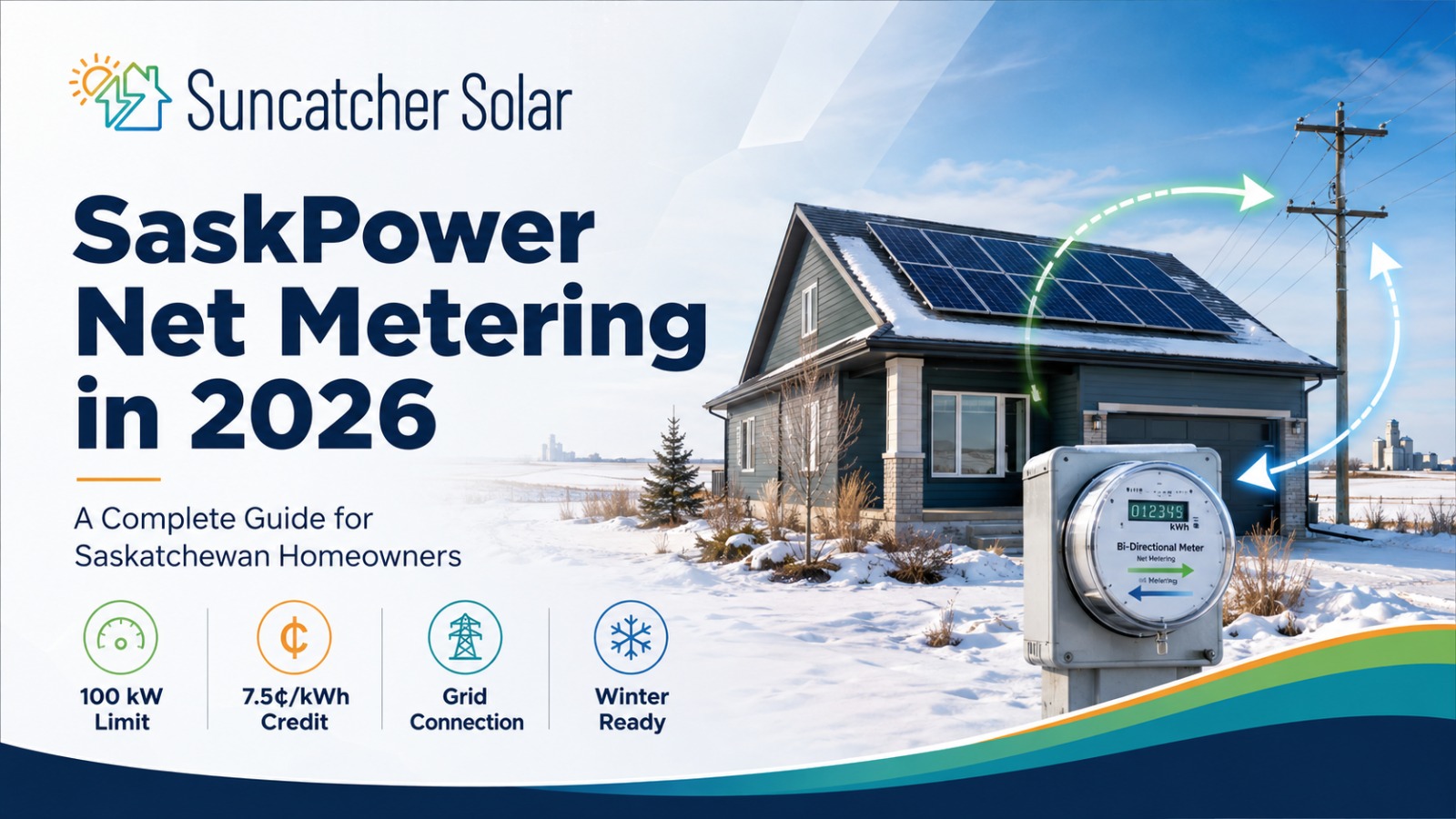
If you are considering solar panels for your home in Saskatchewan, understanding SaskPower’s Net Metering Program is an important step before buying equipment or signing an installation contract. Net metering lets eligible customers generate renewable electricity, use that electricity on site, and receive bill credits for eligible excess power sent back to the SaskPower grid.
The current program is not a one-for-one energy swap. Electricity you use directly from your solar system has a different value from the credit you receive for excess electricity exported to the grid. This guide explains how SaskPower net metering works in 2026, the current credit rate, system limits, application costs, approval steps, and what homeowners should consider before installing solar.
What Is SaskPower Net Metering?
SaskPower’s Net Metering Program allows customers to generate renewable electricity while staying connected to the utility grid. Solar is the most common option for homes.
Eligible customers can install a generation system up to 100 kW DC per customer meter. Most residential systems are much smaller and should be sized according to actual household electricity use.
During sunny periods, your home uses the electricity produced by your solar panels first. If the system produces more than the home needs at that moment, the excess can flow back to SaskPower’s grid. When the panels are producing less than the home requires, electricity is drawn from the grid as usual.
What Is the Net Metering Credit Rate in 2026?
As of 2026, SaskPower credits eligible excess electricity exported to the grid at 7.5 cents per kilowatt-hour. SaskPower currently lists this rate through March 31, 2029.
The credit appears as a dollar amount on your bill and can offset eligible energy charges. It cannot be taken as cash and cannot be applied to taxes or the basic monthly charge. Unused credits can carry forward for the life of the SaskPower account at that address.
This makes self-consumption important. Solar electricity used immediately in your home reduces the amount you need to purchase from the grid. Excess electricity sent to SaskPower receives the current export credit, which is different from the retail rate charged when you buy electricity from the grid.
For that reason, the largest system that fits on a roof is not automatically the best financial choice. A good design starts with your annual energy use and when you use electricity.
How Much Solar Can You Install?
SaskPower currently allows eligible net-metering systems up to 100 kW DC per customer meter.
The right system size depends on your annual electricity consumption, available roof or ground space, roof direction and shading, daytime electricity use, planned future loads such as an EV or electric heating, and electrical service capacity.
A professional solar assessment should use actual electricity bills rather than estimating system size from home square footage alone.
What Does It Cost to Apply?
Utility and regulatory costs are separate from the price of solar equipment and installation.
SaskPower currently lists a non-refundable interconnection study fee of $315, including GST. The study reviews how the proposed system will connect to the grid and identifies whether utility upgrades are required.
A bi-directional meter is also required. SaskPower lists interconnection costs starting at $498.75, including GST, for the meter. Additional charges may apply if the home’s electrical service, SaskPower transformer or other facilities need upgrades.
SaskPower advises customers to complete the interconnection study before making a final project commitment because required upgrades can add significant cost. Homeowners must also meet Technical Safety Authority of Saskatchewan requirements for electrical permits and inspection.
How Does the Application Process Work?
The process involves the homeowner, solar contractor, SaskPower and TSASK.
First, the system is designed with a Licensed Saskatchewan Electrical Contractor. A net metering application is submitted to SaskPower, and the required electrical information is provided to TSASK.
SaskPower invoices the $315 study fee and completes the interconnection study. The homeowner then receives the quote package and program terms. The required meter payment and any identified interconnection costs are addressed before final connection.
The contractor installs the system, SaskPower completes the bi-directional meter work, and TSASK completes the electrical inspection. The solar system should only be energized after the required inspection is complete and SaskPower has finished the necessary meter work.
What Does a Bi-Directional Meter Do?
A bi-directional meter records electricity moving in both directions. It measures the power your home draws from SaskPower and the excess solar electricity your system exports to the grid.
This allows SaskPower to calculate regular electricity charges and credits earned from eligible excess generation. A bi-directional meter is required for all net-metering systems.
Will Net Metering Eliminate Your SaskPower Bill?
Usually, no.
Solar can reduce the amount of electricity purchased from the grid, but a net-metered home still has a SaskPower account. The basic monthly charge, taxes and certain other charges remain.
Savings depend on how much solar electricity is produced, how much is used immediately, how much is exported, and how much electricity is still purchased from the grid. Homes with meaningful daytime electricity use may be able to consume a larger share of their solar generation directly.
What Happens During Saskatchewan Winters?
Solar panels continue to produce electricity in cold weather, but Saskatchewan winters affect overall generation. Shorter daylight hours, snow coverage, roof orientation and seasonal sun angles can reduce production.
SaskPower notes that winter electricity demand is often highest between 5 p.m. and 9 p.m., when solar output may be low or unavailable.
A solar proposal should therefore be evaluated using annual production estimates rather than summer performance alone. Year-round modeling gives a more realistic picture of expected generation and savings.
What Happens During a Power Outage?
A standard grid-tied solar system shuts down during a utility outage for safety. It cannot continue feeding power onto utility lines while crews may be working on them.
If backup power is important, a compatible battery storage system can be included. With the correct equipment and controls, a battery can supply selected household loads during an outage.
How to Get Better Value From Net Metering
Before installing solar, review at least 12 months of SaskPower bills and consider future electricity needs such as an EV charger, heat pump, workshop equipment or home addition.
Improving energy efficiency first can also help. Lowering unnecessary electricity use may allow a smaller solar system to offset a larger percentage of your remaining consumption.
Most importantly, use current SaskPower rules when evaluating a proposal. Be cautious with claims that solar will automatically eliminate your bill or that every exported kilowatt-hour has the same value as electricity purchased from the grid.
Is SaskPower Net Metering Worth It in 2026?
For many Saskatchewan homeowners with suitable solar exposure and consistent electricity use, net metering can be an effective way to reduce grid electricity purchases and improve the long-term value of a solar installation.
The best results usually come from a properly sized system that maximizes useful on-site solar consumption, accounts for Saskatchewan’s seasonal conditions, and follows current utility requirements.
Because electrical capacity and property conditions vary, a professional site and energy assessment should come before equipment is purchased.
Plan Your Solar Project With Suncatcher Solar
Suncatcher Solar has supplied and installed solar energy systems in Saskatchewan since 2003. Its team provides in-house system design and electrical installation for residential, commercial and agricultural projects.
If you are considering SaskPower net metering, Suncatcher Solar can review your electricity use, property, roof or ground space and future energy needs to help determine a suitable system.
Call 1-877-441-2355 or book a free assessment with Suncatcher Solar to start planning your solar project.